




Development and Application of New Techniques and Technologies in Forest Protection Operations
Project Title:
Development and Application of New Techniques and Technologies in Forest Protection Operations
Project Duration:
48 months (September 2025 – September 2029)
Funding Source:
Ministry of Regional Development and European Union Funds of the Republic of Croatia
Total Funding Amount:
EUR 99,012.44
Project Team
Assoc. Prof. Kristijan Tomljanović, PhD – Principal Researcher (Project Lead)
Project Collaborators:
Prof. Danko Diminić, PhD
Prof. Marijan Grubešić, PhD
Prof. Krešimir Krapinec, PhD
Assoc. Prof. Milivoj Franjević, PhD
Assoc. Prof. Marko Vucelja, PhD
Assist. Prof. Linda Bjedov, PhD
Assist. Prof. Jelena Kranjec Orlović, PhD
Marija Majnarić, MSc in Forestry Engineering
Project Summary
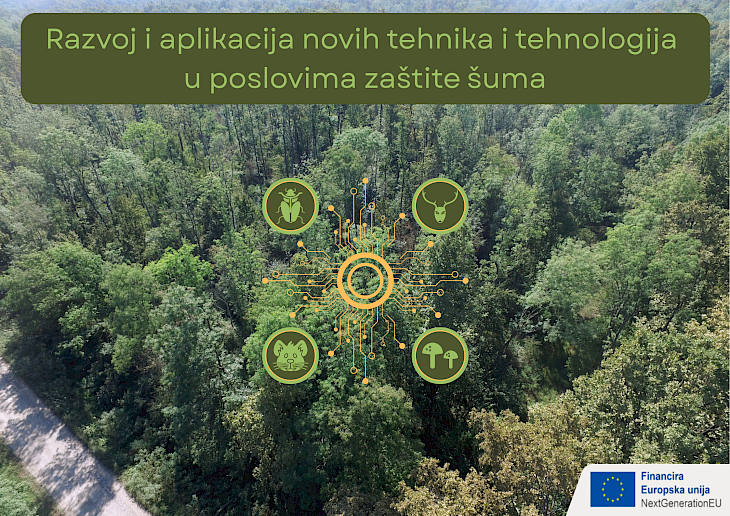
Over a four-year research period, the project aims to develop and implement new techniques and technologies for monitoring biological factors influencing the stability of forest ecosystems and to integrate them into a unified monitoring system.
Within the monitoring of entomofauna and phytopathogenic fungi in lowland floodplain forests dominated by pedunculate oak (Quercus robur) and narrow-leaved ash (Fraxinus angustifolia), a disease detection model is planned to be developed through the integration and correlation of terrestrial field surveys and imagery acquired using Unmanned Aerial Systems (UAS).
For monitoring small rodents that cause forest damage and hinder natural regeneration, a system for population monitoring and early warning is planned to be developed and implemented using camera traps.
In the monitoring of red deer (Cervus elaphus), which cause bark damage to young narrow-leaved ash trees, a model for assessing population size and habitat preferences will be developed through the combined use of UAS-based thermal imaging and GPS telemetry tracking, with the aim of mitigating or reducing harmful impacts.
All stated objectives of the sectoral studies are intended to achieve long-term reductions in response time to identified threats or preconditions for their occurrence, improve diagnostic accuracy, reduce the number of personnel required, lower overall costs, and increase operational efficiency.
Specific Objectives of the Sectoral Studies
- To test the potential of UAS imagery for detecting defoliating insect pest outbreaks in pedunculate oak and narrow-leaved ash stands.
- To test the potential of UAS imagery for detecting infection and assessing crown dieback in narrow-leaved ash caused by Chalara fraxinea.
- To test the feasibility of assessing population dynamics and spatio-temporal distribution of small rodents using camera trap data.
- To test the potential for assessing spatio-temporal activity patterns of red deer in order to mitigate damage within narrow-leaved ash stands using UAS-based monitoring and GPS telemetry.