




Analysis and improvement of working conditions of forestry machinery operators – ErgoForMeh
Basic information about the project:
Acronym: ErgoForMeh
Project leader: Assoc. Prof. Zdravko Pandur
Duration: 48 months (9/2025 – 8/2029)
Funding: Ministry of Regional Development and EU Funds of the Republic of Croatia – competetive project funding
Institutional role (FŠDT): partner
Funding amount (FŠDT): EUR 127,974.61
About the project:
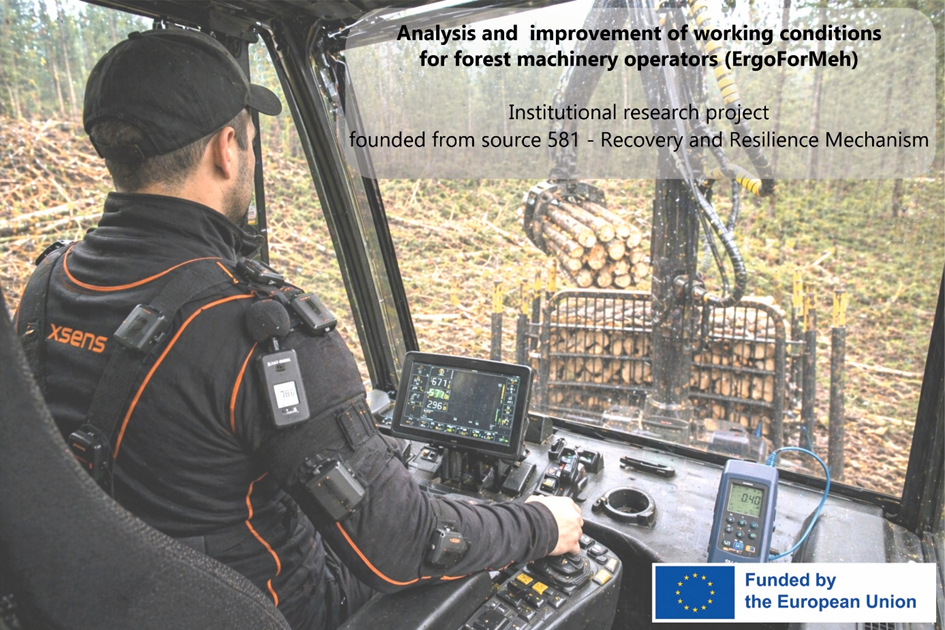
Despite the introduction of modern means of work, work in the forest is considered one of the most dangerous industrial activities with a high proportion of fatal injuries and accidents. The analysis of paper publications according to individual risk factors included in the research emphasizes vibration and cardiovascular and postural workload to the greatest extent. As part of this project, the goal is to achieve the sustainability of the workforce in the forestry production sector through the 4E principle, i.e. to improve ergonomic working conditions, improve labor economy, while it is necessary to reduce energy consumption, which ultimately leads to sustainable or ecological business. In a world of high technological development and internationalization of forestry work and forestry enterprises, the common concern of all stakeholders is to ensure healthy, safe and physically acceptable work for all. The realization of the sustainable development paradigm requires, above all, the achievement of a sustainable workforce. The key role in this is played by the development of a safety culture in forestry, which directly contributes to the achievement of the Global Sustainable Development Goals (GCOR 3, 4, 8, 15). As part of this project, the development of safety culture in forestry will include: analysis of the main indicators of safety at work and assessment of the existing situation, noise and vibration measurement, assessment of work technique, physical and postural load on workers who operate machines in phase II of timber harvesting, i.e. skidder and forward operators, and the impact of unevenness of the surface and indentation of the terrain on the comfort of working with the mentioned machines.
Research procedures will include literature review, development and implementation of a survey questionnaire, field measurements (noise and vibration, evaluation of working technique using visual and Xsens technology, digital pulsometry, field factors – slope, surface obstacles, attraction distance), analysis of postural load using OWAS and REBA methods, and digitization of the database in order to monitor the progress of the research sector.
Project team:
Assoc. Prof. Zdravko Pandur
Prof. Marijan Šušnjar
Prof. Mario Šporčić
Assoc.Prof. Hrvoje Nevečerel
Assoc. Prof. Matija Landekić
Assoc. Prof. Iva Ištok Pandur
Assist. Prof. Matija Bakarić
Assist. Prof. Marin Bačić
Publications and Links:
https://www.croris.hr/projekti/projekt/17751
Keywords:
Ergonomics; skidder; forwarder; occupational safety; 4E principle; noise; vibrations; postural load